
You can add an ungraded custom challenge to any assessment on Coderbyte. Unlike automatically graded challenges, ungraded challenges allow you to manually evaluate candidates' work.
Creating an ungraded challenge
To create an ungraded challenge, navigate to Custom Library > Challenges.
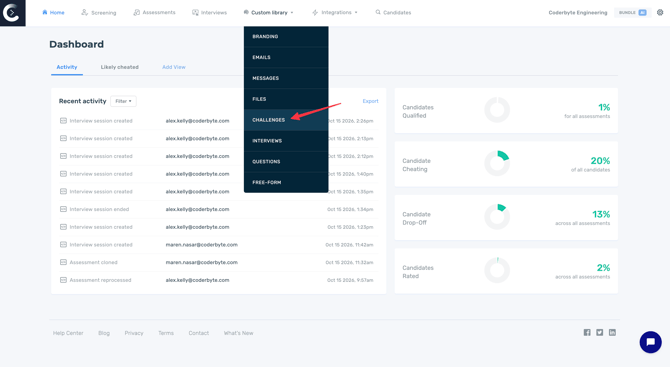
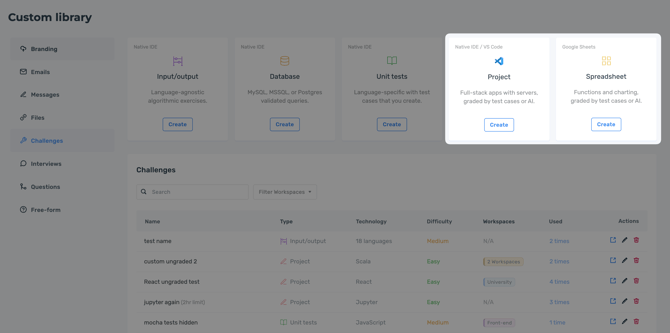
From here, you can create two types of ungraded challenges:
- Project: Create custom coding projects where candidates can work with multiple files, folders, and starter code.
- Spreadsheet: Create custom spreadsheet challenges to evaluate candidates' spreadsheet skills through practical tasks. For detailed instructions, see Create custom spreadsheet challenges.
Configuring an ungraded project
Upon selecting Project, a modal will appear with two IDE options:
- Native IDE (recommended): Pre-installed packages and frameworks with built-in AI grading and cheating detection.
- VS Code IDE (advanced): Set up your project from scratch, or clone from GitHub, and install required libraries. Learn more here.
In the IDE, you can add the following components:
- Instructions for the challenge
- File-tree structure
- Starter code
- AI grading (disabled)
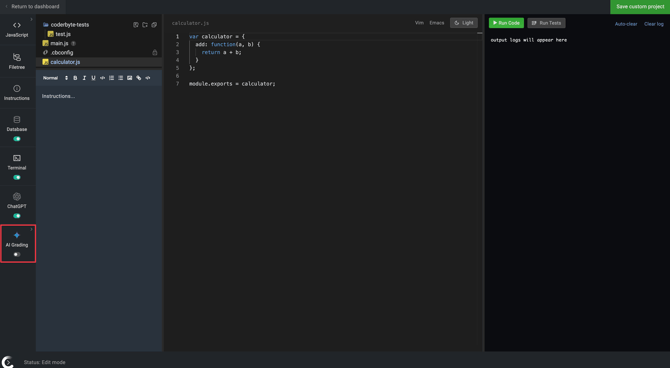
Unlike graded custom challenges, ungraded projects should have AI grading disabled. This allows you to create more complex, real-world tasks that require manual evaluation.
Candidates' work will be recorded and can be watched afterward. Learn more about watching candidate recordings.
Manually grading candidate submissions
After a candidate completes an assessment, you can manually assign a score to an ungraded challenge from their candidate report. You can also override the score for any graded challenge.
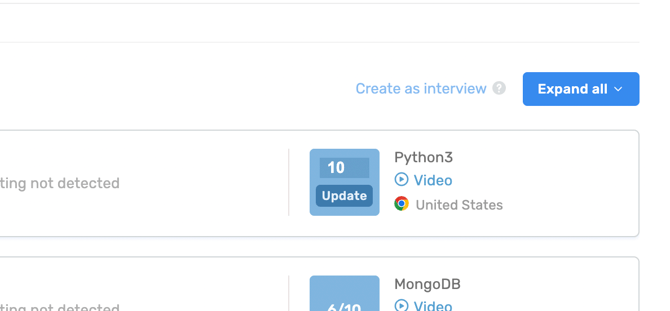
To assign or update a score, click the challenge score, enter a new score, and click Update.
Once a score has been manually changed, a Grade edited label will appear next to it.